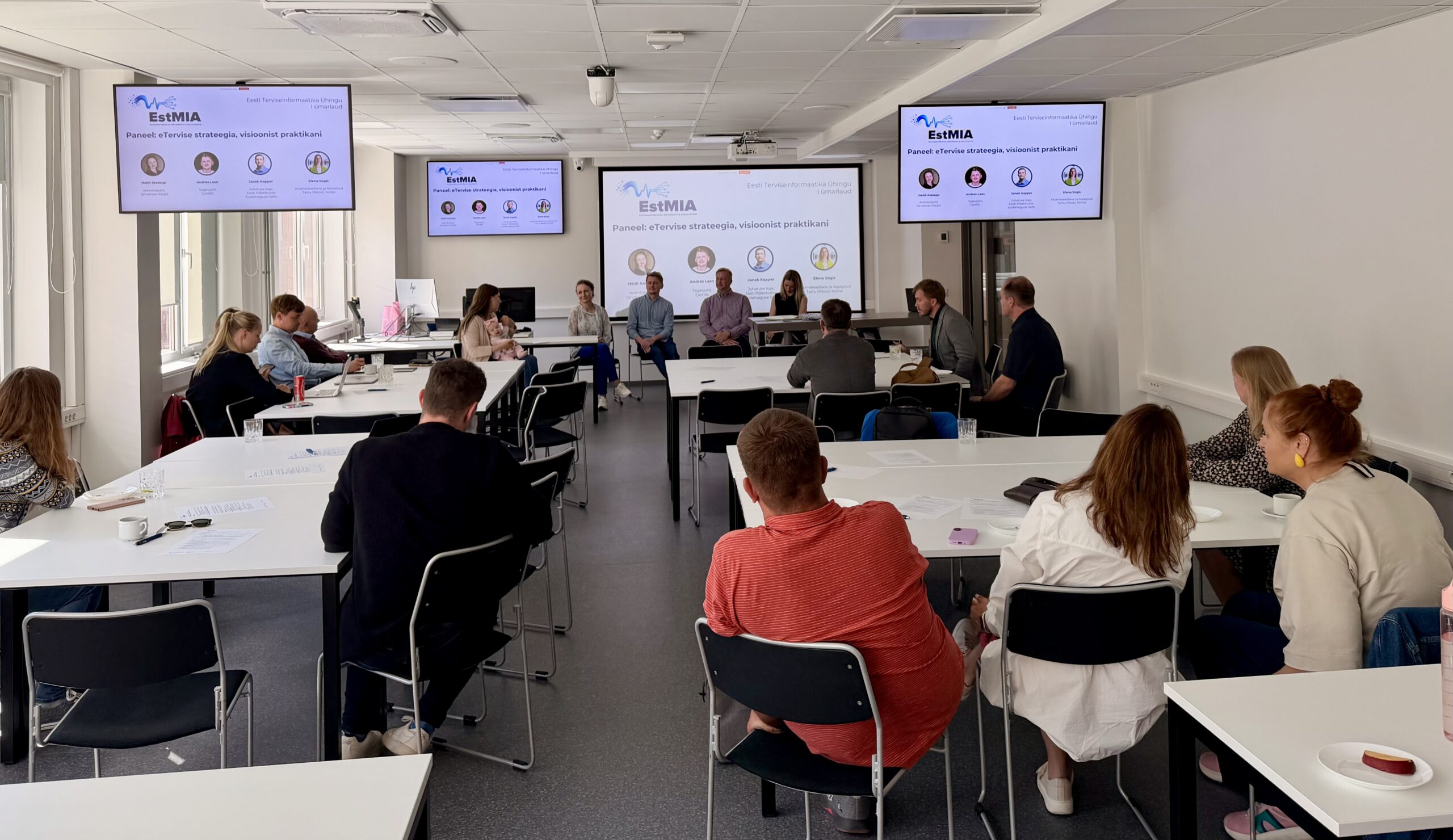
On 10 June, EstMIA held its first roundtable, “E-Health Strategy – What Can the Community Actually Do?”, focusing on how the medical informatics community can contribute to implementing Estonia’s e-health strategy.
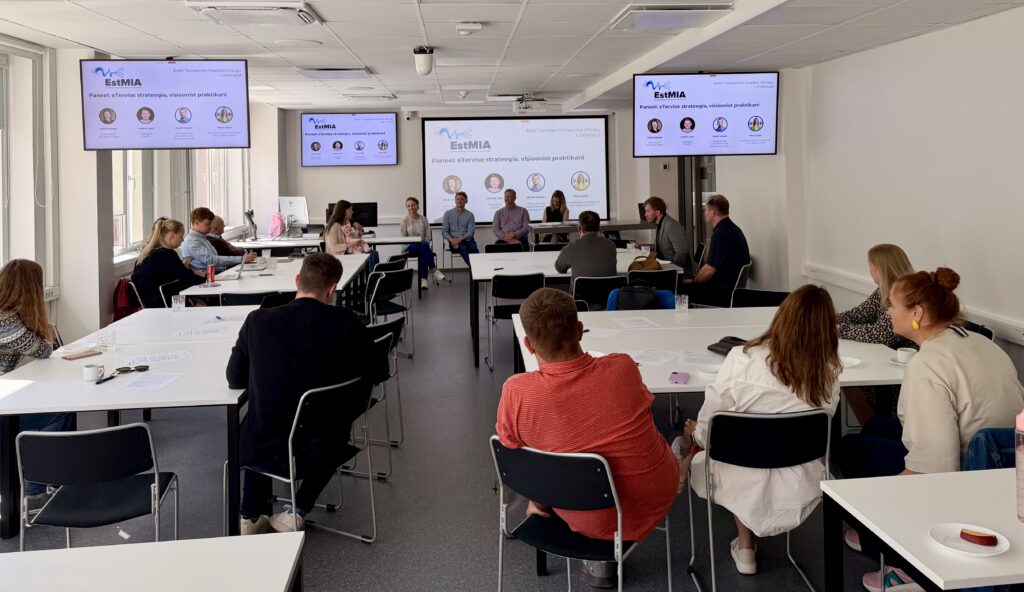
The event took place in a hybrid format at the TalTech Innovation and Business Centre Mektory and online via MS Teams. The roundtable centred on the role the community can play in implementing Estonia’s e-health strategy, and on where EstMIA could help bring stakeholders together, clarify shared challenges and identify practical opportunities for collaboration.
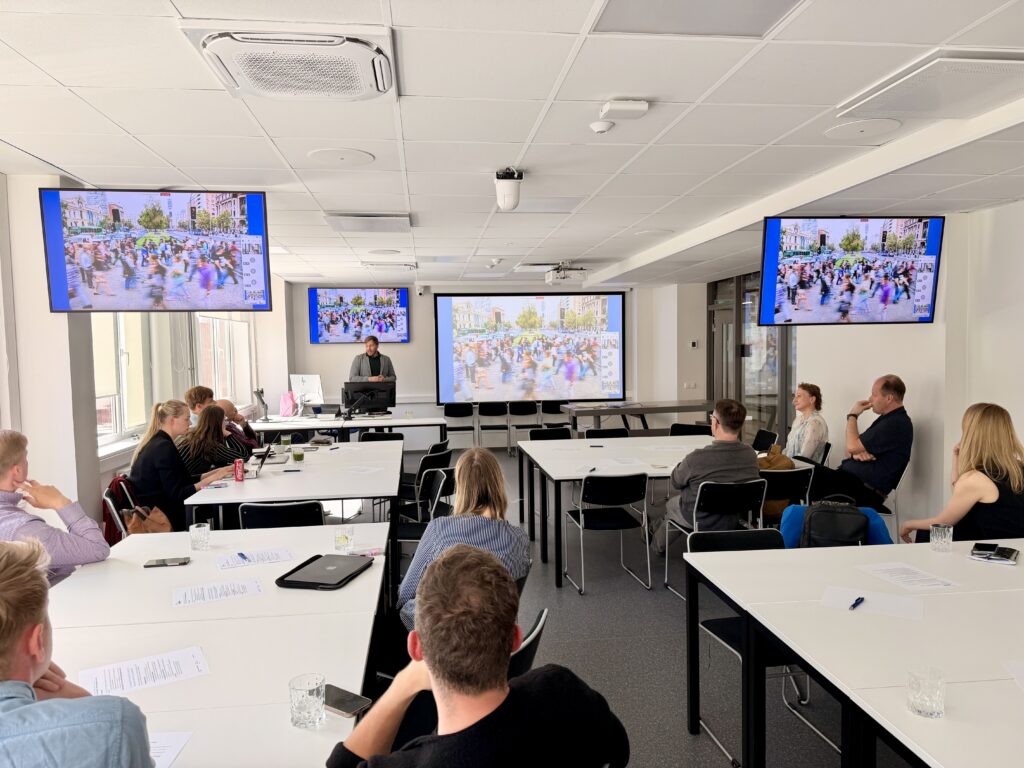
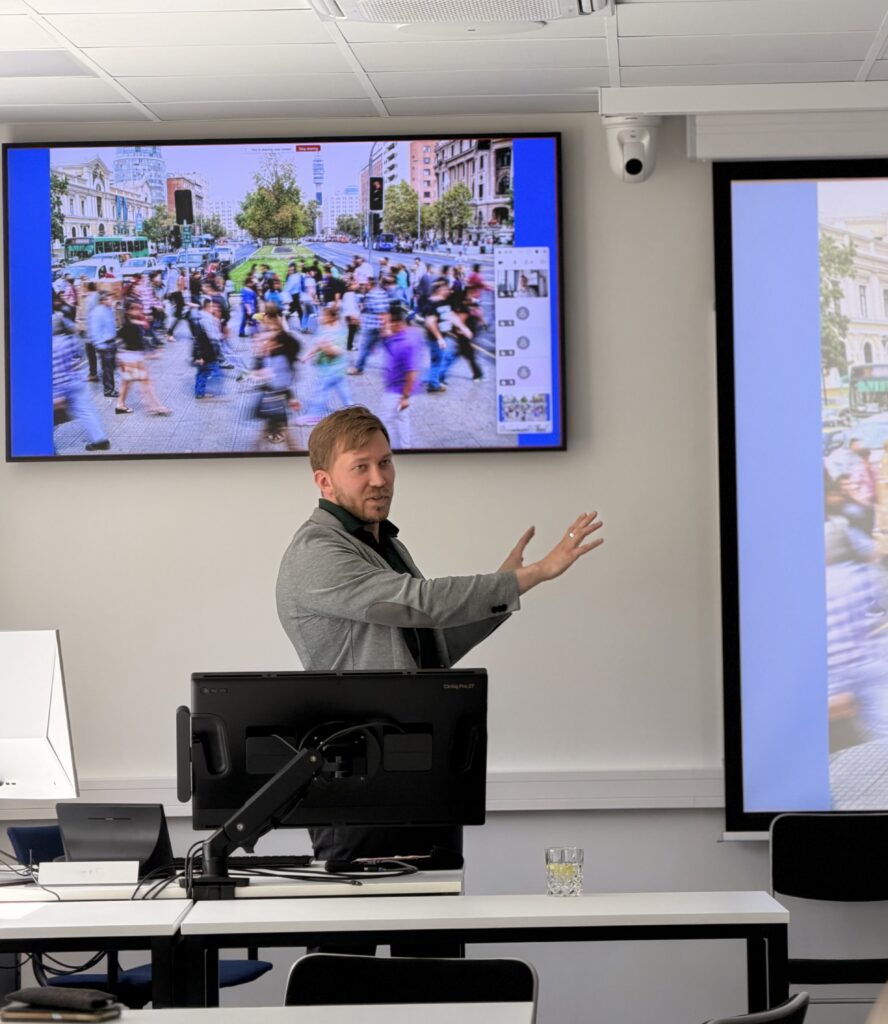
Patrick Pihelgas introduced Estonia’s e-health strategy
The roundtable opened with a presentation by Patrick Pihelgas, Digital Solutions Policy Manager at the Ministry of Social Affairs, who introduced Estonia’s e-health strategy and shared recent thoughts on its implementation. His presentation outlined the main directions of the strategy and the next development leap expected in Estonian e-health.
Patrick’s presentation set the scene for the discussion: the development of e-health in Estonia depends not only on technology or individual information systems, but also on how we use data more effectively, reduce the workload of healthcare professionals, design more user-centred services and bring different stakeholders together around shared goals.
The e-health strategy is available on the website of the Ministry of Social Affairs:
https://sm.ee/sites/default/files/documents/2025-02/E-tervise%20strateegia.pdf
Panel: from vision to practice
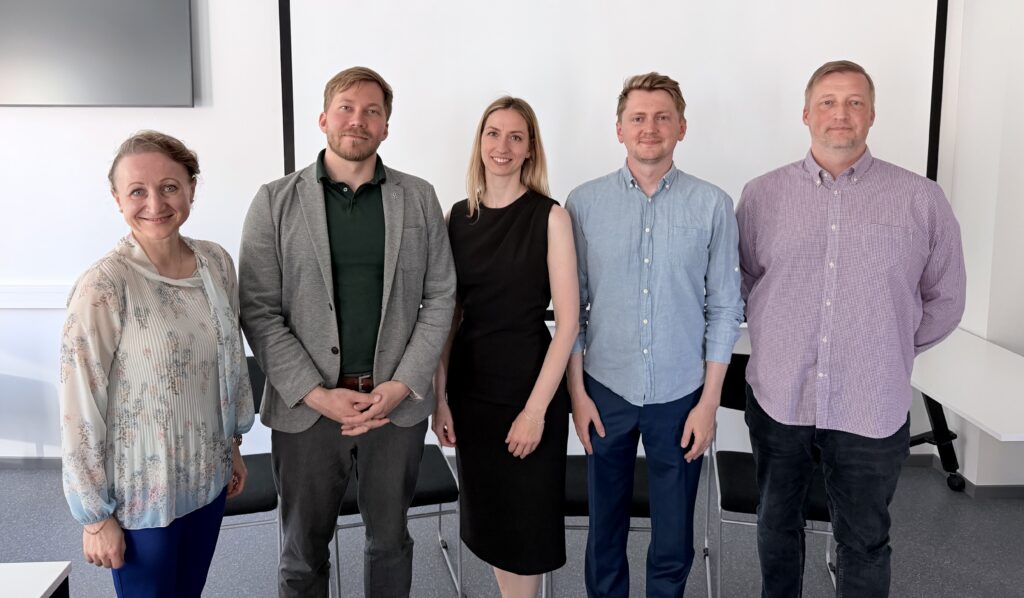
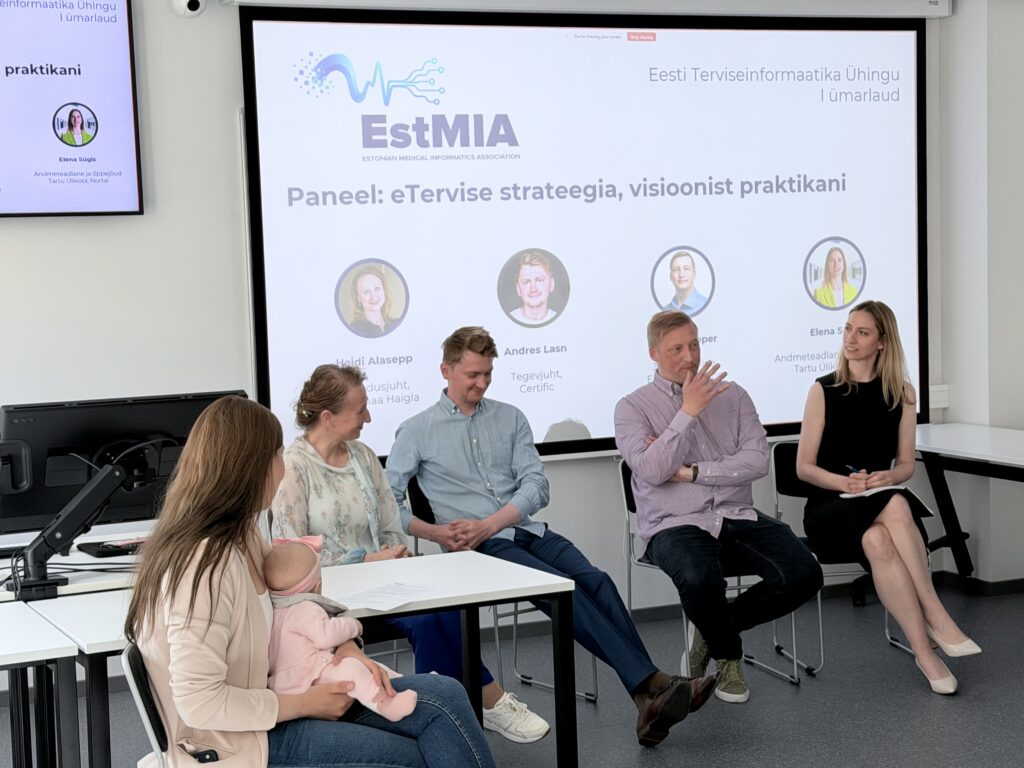
The presentation was followed by a panel discussion titled “E-Health Strategy: From Vision to Practice”, featuring:
- Heidi Alasepp, Development Manager, Järvamaa Hospital
- Andres Lasn, CEO, Certific
- Janek Kapper, Board Member, Estonian Inflammatory Bowel Disease Society
- Elena Sügis, Data Scientist and Lecturer, University of Tartu / Nortal
The panel brought together perspectives from healthcare, patients, research and technology. A recurring theme was the gap between the strategic vision and real-life implementation. While the strategy provides a strong direction, the discussion highlighted that its success depends on practical ownership, resources, collaboration models and the ability to connect new solutions with everyday workflows.
Participants emphasised that patients and communities are still an underused resource and that involvement should be meaningful rather than symbolic. From the healthcare provider perspective, digital tools must support care by saving time, reducing duplication and fitting naturally into clinical workflows. The discussion also highlighted the strong potential of Estonian health data, especially for AI, prevention and research, while pointing to ongoing challenges around data quality, access and measuring the actual impact of e-health solutions.
From the innovation perspective, participants noted the need for clearer collaboration pathways between the state, healthcare providers and private-sector innovators. Across the panel, there was strong agreement that implementation requires co-creation, clearer prioritisation, shared ownership and faster movement from ideas to tested solutions.
Group discussions: what can the community actually do?
After the panel, participants continued the discussion in smaller groups. The aim was to better understand where the EstMIA community could create value, what kinds of activities could be taken forward collaboratively, and around which topics more focused working groups could potentially be formed.
The discussions focused on four themes:
1. Human-centred healthcare
Participants discussed that “human-centred healthcare” is widely used as a concept, but still needs clearer definition and ways to measure it in practice. The community could help develop practical definitions, metrics and feedback methods, for example through patient panels, UX testing and mapping real user journeys.
2. Data and AI
The discussion focused on how the EstMIA community could raise awareness about the opportunities, limitations and risks related to health data and artificial intelligence. Participants highlighted the need to help patients understand where their health data is stored, how they can access it and with whom they could choose to share it. They also saw value in creating a health data and AI knowledge base that would explain how health data can be used in Estonia, which AI solutions may be relevant and what responsible use should look like. The discussion also underlined the need to raise awareness in clinical practice, particularly regarding the use of sensitive health data in public language models.
3. Workload of healthcare professionals
Participants focused on reducing “digital waste”: tasks, systems or processes that take time without creating enough value. Possible next steps included mapping the biggest inefficiencies, co-creating solutions through hackathons or rapid testing environments, and strengthening the validation culture before new tools are deployed.
4. Implementation and resources
The fourth discussion focused on how implementation responsibilities could be shared between the state and the wider community. Participants noted that the community could support the strategy through working groups, pilots, validation activities, university projects, startup collaboration and clearer pathways for bringing new solutions into healthcare.
Watch the recording here
Key takeaways
The roundtable was a step towards identifying more tangible ways in which EstMIA, as a community, can support the development and implementation of e-health in Estonia. To understand where the community can be genuinely useful, we need exactly this kind of shared space: bringing different perspectives together, asking practical questions and identifying where joint effort could create real value.
Several clear messages emerged from the discussion. Estonia’s e-health strategy provides a strong vision, but implementation remains the central challenge. The biggest gap lies between strategic goals and everyday workflows, especially for clinicians and patients.
The community is still an underused resource. Patients, researchers, healthcare professionals, startups and other experts could contribute more if there were clearer structures, recognition and access points for involvement.
Data is central to the future of e-health, but its potential is not yet fully realised due to challenges around quality, accessibility and usability. At the same time, AI, prevention and better use of existing data offer major opportunities.
Finally, human-centred healthcare needs to become more than a slogan. It requires definitions, metrics and continuous feedback from the people who use and deliver healthcare services.
Seeing so many engaged and knowledgeable people in the room gave us reason to be optimistic. There is a strong sense that EstMIA can become a supportive force in Estonian health informatics by helping to connect people, clarify problems and develop ideas that can be taken further together.
EstMIA would like to thank Patrick Pihelgas, the panelists Heidi Alasepp, Andres Lasn, Janek Kapper and Elena Sügis, as well as all participants who contributed their experience, questions and ideas to the discussion.
Leave a Reply